Data Migration
The Foundation of Success: Mastering Data Migration for Microsoft Dynamics 365 F&O
How a Strategic, Clean Data Migration Strategy Transforms Your Legacy Information into a Trustworthy Asset and Accelerates Your ROI
Data Migration
The Foundation of Success: Mastering Data Migration for Microsoft Dynamics 365 F&O
How a Strategic, Clean Data Migration Strategy Transforms Your Legacy Information into a Trustworthy Asset and Accelerates Your ROI
Data Migration
Introduction: Your Most Critical Go-Live Decision
The day your Microsoft Dynamics 365 F&O system goes live is a milestone. But the true determinant of success or failure often happens in the months before, during a process that receives a fraction of the attention it deserves: Data Migration.
Migrating data is not a simple “lift and shift.” It is a strategic transformation of your business information. Legacy data carries the ghosts of old processes, inconsistent definitions, and years of accumulated “data debt.” Simply dumping this information into a pristine, modern system like D365 F&O is a recipe for disaster—it will corrupt your new processes, cripple reporting, and erode user trust from day one.
The old adage holds truer than ever in the cloud era: “Garbage In, Gospel Out.” The quality of your data migration directly dictates the success of your entire ERP investment.
At Rekaz Core, we treat data migration as a foundational business initiative, not a technical afterthought. Our disciplined, multi-phase methodology doesn’t just move data—it cleanses, transforms, and validates your information, turning historical records into a strategic asset that fuels your new digital core.
The Hidden Costs of a Failed or Rushed Migration
When data migration is an afterthought, organizations face severe and immediate consequences:
- Business Disruption at Go-Live: Incorrect inventory balances halt shipping. Invalid customer records block invoicing. The business grinds to a halt.
- Erosion of User Trust: If the new system shows wrong numbers on day one, users will abandon it and retreat to their familiar spreadsheets, dooming adoption.
- Financial & Reporting Inaccuracy: Faulty general ledger balances, incorrect open receivables/payables, and flawed cost data lead to bad decisions and audit issues.
- Compromised Process Efficiency: “Dirty data” forces teams into manual workarounds within the new system, nullifying the benefits of automation.
- Extended Stabilization & Cost Overtuns: Weeks or months of post-go-live “data cleanup” projects burn budget and divert resources from value-adding activities.
Our Philosophy: The Three Pillars of Successful Migration
We build every migration on three non-negotiable principles:
- Business Ownership, IT Execution: Data is a business asset. We partner with your subject matter experts (SMEs) in finance, sales, supply chain, etc., who define the rules. Our technical team executes.
- Clean Before You Load: The heavy lifting happens in the staging environment, not in production D365 F&O. We fix, deduplicate, and enrich data before it touches your new system.
- Validate, Validate, Validate: Every record is scrutinized through automated checks, SME review, and business process validation. We prove data quality before cutover.
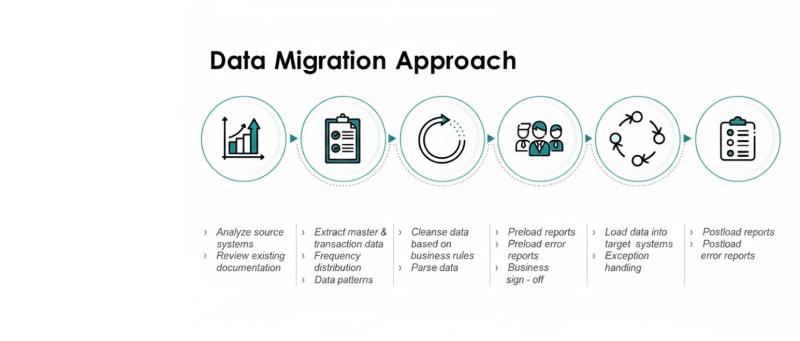
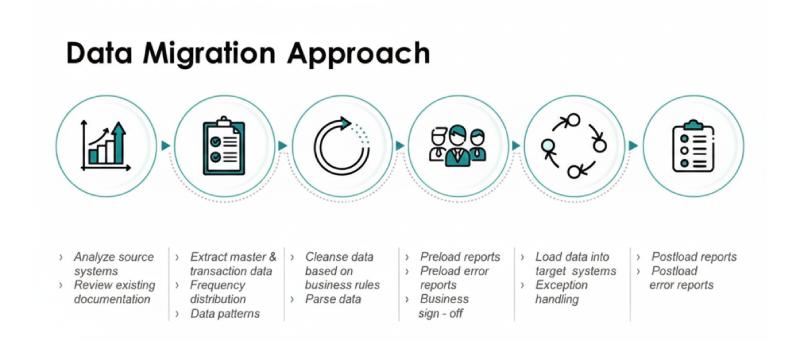
Our Proven Data Migration Framework: A Six-Phase Journey
Phase 1: Strategize & Discover
We start by asking why, not how.
- Data Governance Kick-off: Establishing the business-led steering committee and defining “data owners.”
- Legacy System Inventory: Cataloging all source systems, files, and spreadsheets.
- Migration Scope & “Data Quality Amnesty”: Deciding what historical data to bring forward (e.g., 2 years of open transactions, 5 years of closed orders) and declaring a “clean slate” for obsolete records.
- Business Rules Definition: Collaborating with SMEs to define transformation rules (e.g., “Map all legacy customer types A, B, and C to the new ‘Standard’ type in D365”).
Phase 2: Design & Architect
Building the blueprint for transformation.
- Target Data Model Mapping: Detailed mapping of every source field to its destination in D365 F&O’s complex data structures (e.g., CustTable, InventTable, LedgerJournal).
- Staging Environment Design: Architecting the secure Azure SQL database or Dataverse environment where all cleansing and transformation will occur.
- Tool Selection & Automation: Leveraging Azure Data Factory, SQL Server Integration Services (SSIS), and our proprietary accelerators to automate the extract-transform-load (ETL) process.
- Validation Rulebook: Creating the automated and manual checklists that will prove data integrity.
Phase 3: Extract, Cleanse & Transform (The Heart of the Work)
This is where legacy data is reborn.
- Initial Extract & Profiling: Pulling sample data and generating quality reports that show duplication rates, fill rates, and validity failures. This “ugly truth” report guides the cleansing effort.
- Cleansing Workshops: Working with business owners to resolve conflicts (e.g., “We have three different spellings for ‘LLC’ in vendor names—which is correct?”).
- Strategic Data Enrichment: Augmenting data where needed (e.g., adding missing commodity codes, standardizing address formats with a service).
- Transformation Execution: Applying all business rules in the staging environment. This is an iterative, collaborative process.
Phase 4: Validate & Rehearse
Proving the data is ready for prime time.
- Technical Validation: Automated checks for data type compliance, referential integrity (e.g., every sales order line has a valid item), and mandatory fields.
- Business Validation: SMEs review sample record sets in a mock D365 environment. “Do these migrated customers look correct? Does this trial balance match our legacy report?”
- Dry-Runs (The Dress Rehearsals): Multiple full migration executions into a sandbox D365 environment. We measure performance, refine the cutover timeline, and build the team’s confidence. We succeed in rehearsal so you succeed at go-live.
Phase 5: Execute & Cutover
The final, orchestrated move to production.
- Final Data Capture & Delta Migration: Executing the last extract from legacy systems after business closure, migrating only the changed records since the main load.
- Production Load: Executing the automated, validated packages to load data into your live D365 F&O environment.
- Post-Load Verification: Running a battery of final integrity checks and key report comparisons (e.g., “Does the migrated Accounts Payable subledger reconcile to the legacy total?”).
Phase 6: Stabilize & Govern
Ensuring long-term data health.
- Hypercare Support: Dedicated migration experts are on call during the first days of go-live to answer data-related questions.
- Data Governance Handoff: Providing tools, documentation, and training to help your team maintain the new standards for data entry.
- Archive Legacy Systems: Establishing a formal, compliant archive of legacy data for historical reference and audit needs.
Key Technical Challenges & Our Solutions
- Master Data Dependencies: You can’t load Sales Orders before Items and Customers. We architect sophisticated, multi-pass load sequences to respect all D365 F&O dependencies.
- Open Transaction Integrity: Migrating open orders, unpaid invoices, and work-in-process inventory requires surgical precision. We build reconciliation bridges to ensure nothing is lost.
- Historical Data Volume: Bringing years of history for reporting. We advise on smart archival strategies and may leverage Azure Synapse for historical analytics, keeping D365 F&O performant.
- Data Quality Tooling: We utilize Microsoft Purview and SQL quality services to profile, catalog, and monitor data quality throughout the journey.
Why Rekaz is Your Essential Migration Partner
Data migration is a unique discipline. Our specialization ensures your success:
- D365 F&O Data Model Expertise: We know the specific tables, fields, and mandatory sequences required for a clean load. We’ve mapped countless legacy systems to this model.
- Proprietary Accelerators: We bring pre-built mapping templates, validation scripts, and ETL packages that dramatically reduce time, cost, and risk.
- “Business-Facing” Technical Team: Our consultants can explain a complex data issue to a CFO and then write the SQL code to fix it.
- Focus on Business Outcomes: We align every step of the migration to the goal of a smooth, trustworthy Day 1 experience for business users.
Conclusion: Data Migration is Your First Business Process in the New System
How you migrate your data sets the tone for everything that follows. A disciplined, clean migration builds immediate confidence and unlocks the full potential of your Dynamics 365 F&O investment. It is the first and most critical business process you will execute in your new digital era.
Don’t let your past data haunt your future success.